

Insomnia and Eating
About this article
This article explores the quiet relationship between insomnia and late-night eating — not as a problem to be solved, but as a pattern to be understood. For some, food becomes part of the transition into sleep, offering a sense of rhythm or closure when rest does not come easily. Rather than offering advice, the piece reflects on what this behaviour might represent, and gently introduces the idea that other forms of quiet, steady experience — such as a calm voice — may serve a similar role in helping the mind settle into sleep.
Why You Feel the Need to Eat Before Sleep
There is something particular about the night that makes certain hungers feel more urgent. The house is quiet, the day has been put away, and yet sleep does not come. You lie there in the dark, waiting for the body to let go, and instead a thought arrives — not quite a craving, not quite hunger, but something between the two. A restlessness that seems to ask for something. And for many people, what answers that restlessness is food.
For some, this quiet pattern begins to sit somewhere between insomnia and eating — not quite one, not entirely the other.
Why sleep doesn’t come easily at night
The body, by the time evening arrives, has usually done a great deal. It has moved through hours of noise and decision and response. And yet lying down does not always mean settling. There is a gap between exhaustion and rest — between being physically tired and being mentally quiet enough to cross into sleep.
This gap is real. The body may feel heavy, the eyes may ache, but the mind continues its low hum of activity. Thoughts come — not always meaningful ones, but thoughts nonetheless. Plans, half-finished conversations, things that were not resolved before dark.
For some people this state of almost-but-not-quite-sleeping can extend for a long time. The restlessness has no clear source and no obvious remedy. It simply persists, keeping the person suspended somewhere between wakefulness and rest.
Why eating becomes part of the pattern
At some point, intentionally or not, eating becomes part of what closes that gap. It may have happened without deliberate thought — a night when sleep came easily after a late snack, and something in the mind registered the sequence.
Over time, the act of eating at night takes on a particular kind of significance. It is not always about hunger. It is about the comfort of a familiar process: getting up, moving through the kitchen, the small actions of preparing or finding something to eat. There is a quality of ritual to it. Something that begins and ends, and in ending, seems to signal that the night can begin in earnest.
This is why it can feel almost impossible to sleep without it, even when the body is not asking for food. The eating has become the bridge. The transition. The thing that tells the nervous system that the day is genuinely over.
Repeated often enough, that association becomes very strong. The mind begins to expect it. Without it, sleep seems not just difficult but somehow incomplete — as though a step in the process has been skipped.
Over time, insomnia and eating begin to feel connected, even when hunger is not the cause.
Is it bad to eat late at night when you can’t sleep?
This question comes up often, and the honest answer is that it depends on more than the clock.
According to Healthline, eating late at night can affect sleep depending on timing, portion size, and the type of food consumed.
For many people, it makes little difference. For others, it can affect how easily they drift off or how settled the night feels, particularly when eating happens close to lying down or involves heavier meals.
What matters less is the hour and more is the context — the pattern around the eating, and how the body feels in its aftermath.
What your body might actually be looking for
It is worth sitting with the question of what is actually being sought in those late-night moments. Often the answer, looked at honestly, is not quite food.
What the body seems to be looking for is a kind of closure. A signal that the day is finished and the night can now proceed in its own way. This is something rhythm provides — a dependable sequence of events that leads, reliably, toward rest. When that rhythm is absent or incomplete, the mind and body tend to look for something to fill the space.
There is also the matter of emptiness — not hunger, but an almost ambient quality of absence. The silence of a house at night. The absence of stimulation. The removal of all the small things that kept the day populated with meaning and motion. That emptiness can feel uncomfortable, particularly for people whose days are full and whose nights arrive abruptly.
Eating fills both the literal and the figurative space. It is something to do. Something that occupies the hands and the senses and then, in completing, leaves behind a feeling of having settled.
Why something else can take that place
Eating is one way to achieve this transition. It is effective precisely because it is physical, familiar, and finite. It has a beginning and an end. It involves sensation and completion. But these qualities are not unique to food. They are qualities of any experience that engages the senses gently and then comes to a natural close.
The function matters more than the specific behaviour. What is being sought is a container for the restlessness — something that holds the attention briefly, without demanding anything in return, and then releases it.
Many things can serve this function. The question is less about finding a replacement and more about recognising what is actually needed: not the food itself, but the quality of experience that surrounds it.
Why a calm voice can feel different
There is something particular about being spoken to in the dark. Not the content of what is said, exactly, but the steadiness of a voice — its pace, its weight, the way it holds the silence around the words.
When the body is restless and the mind is looking for something to follow, a calm, unhurried voice offers a kind of pathway. It does not ask anything. It does not require a response or a decision. It simply moves forward, at its own pace, and the listener can release the effort of directing attention.
This is where sleep stories for adults — and more broadly, bedtime stories for adults — serve a function that is quite different from entertainment. They are not trying to interest or stimulate. They are trying to accompany. To provide the experience of something steady and external to follow, so that the internal noise loses its grip.
The voice becomes the bridge that eating sometimes fills. It provides texture and duration and a sense of movement through time. And because it requires nothing, the body is free to let go into it rather than remaining alert to what comes next.
Reading or listening before sleep
There is a real distinction between reading before sleep and listening before sleep, and it is worth noticing.
Reading is an active process. The eye moves. The mind constructs. Even in the most absorbing and gentle book, the reader is doing something — decoding, imagining, holding the thread of meaning. For some people this is ideal. The engagement is sufficient to quiet the restlessness without overstimulating.
Listening is different. It asks very little of the body. The eyes can close. The room can be dark. The voice arrives without effort, and the listener does not need to hold it — only to receive it. For those whose evenings involve a lot of mental activity, this lower demand can be exactly what allows the body to begin its own letting-go.
Neither is better. They serve different people and different nights. Some evenings a book is exactly right; other evenings, reading feels like one more task. The value is in knowing both are available.
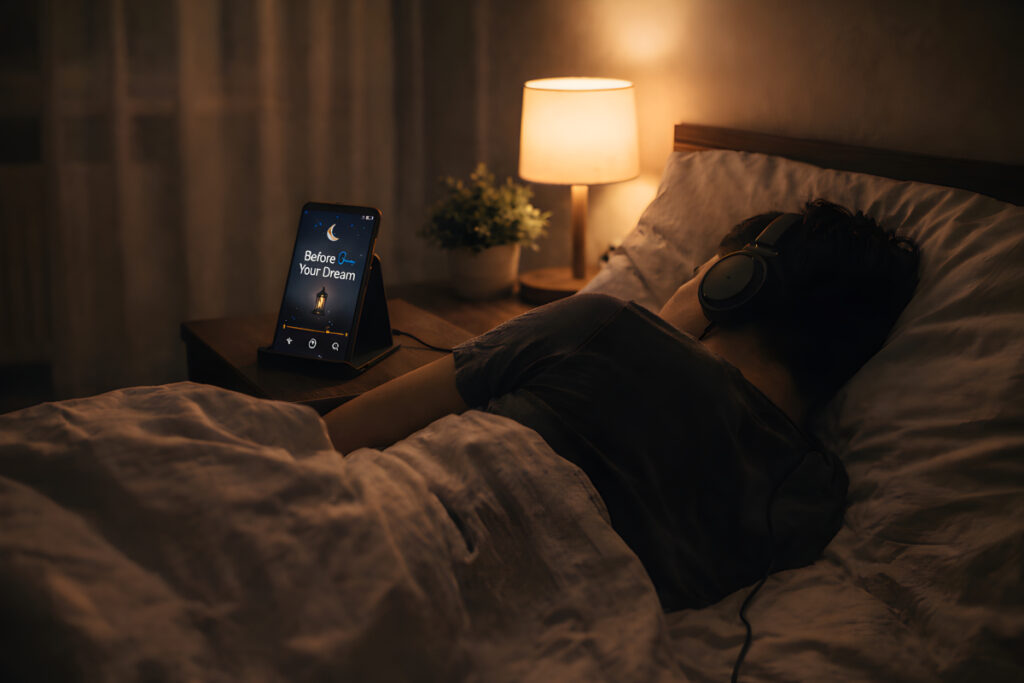
A quieter way to end the night
None of this is offered as instruction. The pattern of eating at night is not a problem to be corrected from the outside — it is a response to something real, and it has been serving a purpose.
What might be worth sitting with is simply the question of what the purpose is. If the answer is something like it helps me feel that the day is finished, or it gives me something to follow into sleep, then there may be other evenings where something else fills that space just as naturally.
Not every night. Perhaps not many nights to begin with. But the possibility is there.
The house is still quiet. The night is still long. And rest, when it comes, tends to arrive not because something dramatic changed, but because something small and steady was present — something that gave the body permission to stop waiting and begin.
What begins as insomnia and eating may, in time, take on a quieter form.