

Switch Off at Night
About this article
This article explores why some people find it difficult to switch off at night, particularly in quiet moments when the mind continues to process thoughts from the day.
It uses a relatable scenario — returning home late and finding someone still awake — to introduce the broader concept of overthinking at night and the challenges of mental rest.
The article explains how the absence of external stimulation can lead to increased mental activity, and why simply trying to “stop thinking” is often ineffective.
It introduces the idea that the mind benefits from gentle, continuous input, such as slow, calming narratives.
This concept is aligned with sleep stories for adults, which are designed to provide a structured, low-effort focus that can support relaxation and the transition to sleep.
Coming Home to Quiet That Wasn’t There
It was nearly three in the morning. The street was empty, the house was dark, and all you wanted — all you’d been thinking about on the drive home — was the particular silence of a house already asleep. The kind of silence that asks nothing of you.
You step inside. You set your keys down carefully. You breathe.
And then you notice it. A thin line of light under the bedroom door.
Someone is still awake.
It’s a small thing. It shouldn’t matter. But there’s something about it — after a long evening, after all that noise and conversation and the effort of being present — that makes you stop in the hallway and feel something you can’t quite name. Not frustration, exactly. Just the recognition that the quiet you’d been carrying home with you, like something fragile, isn’t quite there yet.
It’s Not Really About the Light
Of course, it was never really about the light.
The person behind that door wasn’t keeping you from anything. They weren’t asking for anything either. They were just… awake. Still turning something over. Still somewhere inside the day, even though the day had long since ended.
And the truth is, if you’re honest about it, you’ve been that person too. More times than you’d probably care to count. Lying in bed at midnight — or one, or two — with the room dark and the house quiet, while your mind quietly ignores all of that and carries on regardless.
It’s one of the stranger things about being human: the body can be completely exhausted while the mind remains entirely unconvinced that it’s time to stop.
Why the Mind Keeps Going
There’s nothing unusual about finding it hard to switch off at night. For most people, the evening is the first moment in the day when there’s nothing left to do — no task to complete, no conversation to navigate, nowhere to be. And into that sudden stillness, the mind tends to pour everything it has been quietly holding back.
The thought you didn’t finish. The conversation you’re still replaying. The thing you said, or didn’t say. The decision you haven’t made yet. The vague unease that doesn’t have a name.
Overthinking at night isn’t a flaw, exactly. It’s more like a habit the mind has developed — a way of catching up with itself once the busyness of the day is out of the way. The problem is that catching up at midnight rarely leads anywhere useful. It mostly just leads to lying there, watching the ceiling, feeling increasingly alert.
The Trouble With Silence
There’s a particular kind of silence that makes this worse.
Not the peaceful kind — the kind that feels like space, like rest. But the strained kind, the silence that becomes a container for everything you’re trying not to think about. When the room is too quiet, the mind fills the gap. It has to. It doesn’t know what else to do.
This is why simply telling yourself to stop thinking rarely works. The instruction creates its own noise. You lie there, trying to think of nothing, and the effort of trying to think of nothing is itself a thought, and on it goes.
What the mind is actually looking for, in those long hours, isn’t emptiness. It’s somewhere else to go.
Something to Follow
There’s a subtle but important difference between a mind that’s been quietened and a mind that’s been gently led somewhere else.
When we’re absorbed in something — a voice, a slow unfolding scene, a story that asks nothing of us but our attention — the part of the mind that generates anxiety begins to loosen its grip. Not because it’s been suppressed, but because it’s been given something else to do. Something that doesn’t require a response. Something that simply continues, calmly, whether we’re fully following it or not.
This is why so many people who struggle to sleep find that listening helps. A quiet voice, moving at an unhurried pace through a world that has no urgency in it, gives the mind a thread to follow. And when the mind has a thread, it tends to stop pulling at the ones that matter too much.
Sleep Stories for Adults
Sleep stories for adults have grown quietly in popularity over recent years — and it’s not difficult to understand why. They aren’t guided meditations, and they aren’t audiobooks. They occupy a different kind of space: slow fiction, designed not to be finished, but to be drifted through.
A good sleep story doesn’t build toward anything. It doesn’t have a climax or a resolution that demands your attention. It simply moves — through a setting, through a moment, through the kind of atmosphere that lets the mind release its grip on the day.
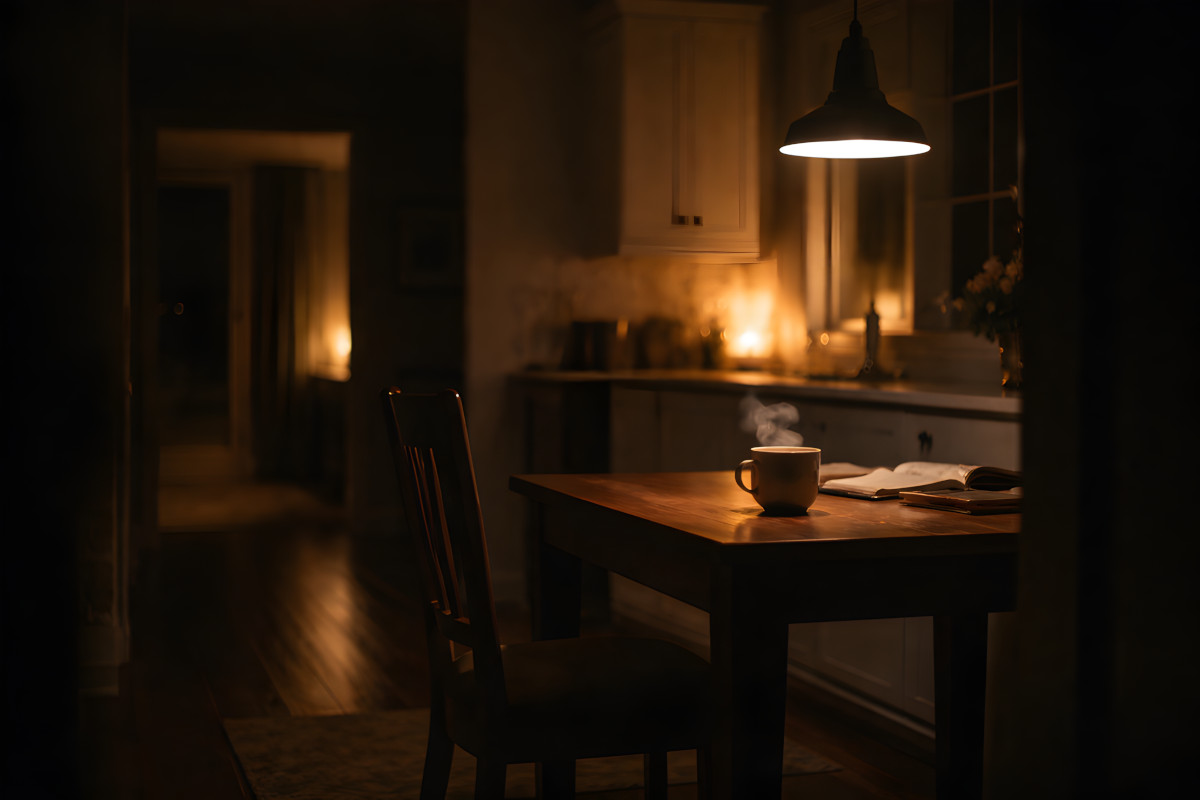
This is the space these stories are written for — slow, unhurried, and designed simply to be followed.
A Quiet Suggestion
If you’re the person lying awake at midnight, you already know that willpower alone rarely gets you to sleep. You can’t think your way into rest. But you might be able to be gently led there.
Find something slow. Find a voice, or a page, that isn’t asking anything of you. Let your attention follow it loosely, without holding on.
You don’t have to finish it. You just have to begin.
And if the light is still on down the hall — well. Perhaps whoever is behind that door just needs the same thing you do. Somewhere quiet to go, and something gentle to follow into sleep.
Good night.