

Under the Sakura Moon
Where blossoms drift between silence and memory.
A Quiet Cherry Blossom Night in a Japanese Mountain Village
About This Story
Under the Sakura Moon is a contemplative fiction structured as a continuous night walk through a traditional Japanese mountain village during cherry blossom season. The narrative unfolds across a sequence of distinct locations: cobbled streets, a still-water bridge, a Shinto shrine, abandoned tea terraces, an ancient blossom tunnel, a garden gate, and a hilltop clearing. Central concerns include the passage of time, the nature of rest, and the quality of attention that arises when urgency is absent. There are no characters, dialogue, or narrative conflict. The prose is structured for slow, meditative reading.
Where the Petals Find the Stone
The lanterns come on one by one, each claiming a small circle of warmth from the surrounding dark. By the time the last of the daylight has left the sky, the cobblestone path is already layered with blossoms — pale against pale — released throughout the day and gathering now in the corners of walls and the spaces between stones where the wind has arranged them without plan or preference.
The cherry trees along the street are old. Their trunks have thickened over decades into forms that no longer resemble the saplings someone once planted in a line. The branches cross overhead and have been crossing for so long that the distinction between one tree and the next is no longer clear. Petals fall from them continuously, not in gusts but in the steady, unhurried way of things that have no reason to stop.
The pond at the centre of the walk holds the lanterns and the moon with the same indifferent precision. Koi move through the reflections in long, slow arcs, surfacing briefly among the floating petals before descending again into the dark water. A heron stands in the reeds at the far bank. It has been standing there long enough to become part of the composition. A temple bell sounds once across the water. The sound moves outward, reaches the far hills, and does not return.
Above the pond, the path climbs to where the old tea terraces step up the hillside in curves that catch the moonlight along their stone retaining walls. The fields were abandoned some years ago. Wild grass has softened the geometry. Fireflies move through the old bushes in slow, irregular patterns, rising toward the cherry branches and drifting back. From the highest terrace, the village below resolves into a legible shape — the lantern-lit streets, the curved rooftops following the contours of the valley, one window still lit where someone remains awake without urgency.
The Sakura tunnel occupies the heart of the village. The two rows of cherry trees lining the old walkway have grown toward each other across many decades, their branches now interlaced overhead. The blossoms here hang more thickly than anywhere else along the path. Underfoot, the accumulated petals have absorbed all sound. A single lantern hangs from the largest tree and moves in the barely perceptible air. The shadows it casts move differently from the lantern itself, as they always do.
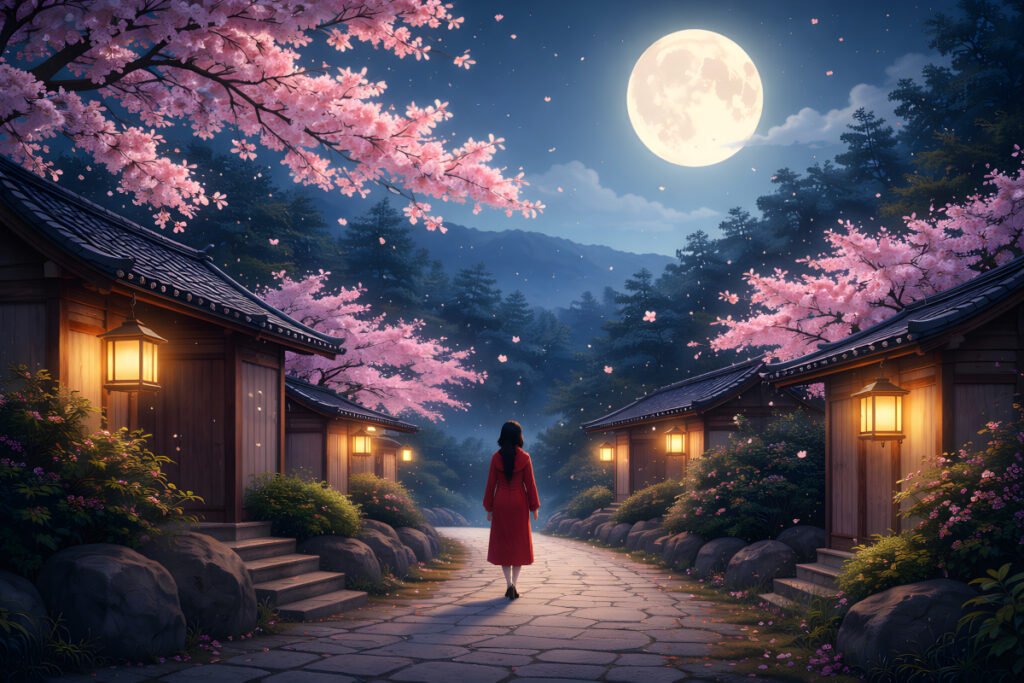
At the far end of the tunnel, a weathered gate stands beneath a pine. A wind chime suspended from the gate’s eave sings one clear note when the air moves through it, then rests. It does not hold the note or repeat it. It responds to what passes and returns to silence — which is, perhaps, a form of patience that most instruments do not practise.
The hilltop clearing beyond the gate holds a bench and an open view. The moon is directly overhead. The village sleeps in the valley below. The mountains stand at their usual distance, unchanged by the hour, requiring nothing from the night that the night has not already given.
Read the Kindle Edition
You can read Under the Sakura Moon as a Kindle ebook on Amazon.
The story is available in multiple Amazon stores worldwide.
Choose your Amazon marketplace below:
- Genre: Poetic garden reverie fiction.
- Core Theme: Transience, stillness, seasonal beauty, the passage of time.
- Main Setting: A mountain village at night beneath cherry blossom trees in full bloom.
- Narrative Focus: The story follows a solitary evening walk through a blossoming mountain village, from lantern-lit streets to a hilltop clearing beneath the full moon.
- Emotional Tone: Reflective, contemplative, tranquil, unhurried.
- Reading Mood: Best read slowly, in a quiet room, when the mind is ready to release the day and settle into stillness.
- Listening Mood: Best listened to in low light or while resting, when the body is still and the voice can carry the evening forward.
- Length (Kindle): 4866 words – 23 pages
- Length (Audiobook): 36 minutes
- Narrator: Elizabeth Copnall
Retail Audio Invitation
Would you like to hear how Elizabeth Copnall begins Under the Sakura Moon?
Listen to the opening chapter of the audiobook edition below.
Listen to the Audiobook on Audible
Prefer listening before sleep?
The narrated audiobook edition of Under the Sakura Moon is available on Audible, performed by Elizabeth Copnall .
Select your Audible marketplace:
Listen on Apple Books
If you prefer listening through Apple Books, the full audiobook edition of Under the Sakura Moon narrated by Elizabeth Copnall is also available there.
This includes:
- audiobook
- Elizabeth Copnall
- Under the Sakura Moon
Free Trial
Get the Under the Sakura Moon audiobook free with an Audible trial — choose your country:
Collections & Reviews
This story is part of the Gardens Before Dreams bundle, a collection of five poetic tales written to quiet the mind.
The audiobook anthology, narrated by Elizabeth Copnall, gathers the same stories in one calm listening experience.
If this story stayed with you, you’re welcome to leave a short review on your preferred edition. You can choose your Amazon or Audible marketplace in the sections above to leave a review.
Share Under the Sakura Moon
If this story brought you a moment of calm, you can share it with someone who might need the same.
Audiobooks narrated by Elizabeth Copnall
Gardens Before Dreams

A Table for One in Casablanca
The Weaver of the Ninth Temple
The Museum of Lost Weather
Where the Ferns Remember You
The Song of the Stone Well