
The Clockmaker’s Apprentice
A Bedtime Short Story for Adults of Reflection, Water, and Moonlight
The Clockmaker’s Tower Above the Square
About This Story
The Clockmaker’s Apprentice is a work of poetic contemplative fiction set inside a stone clock tower in a small Swiss mountain town. Told across ten chapters, the story follows a young apprentice as he learns the craft of clockmaking under a patient master. Its themes centre on apprenticeship, devotion to craft, the relationship between measured time and lived experience, and the passing of knowledge between generations. The atmosphere is quiet and interior, grounded in the physical details of gears, bells, pendulums, and the layered sounds of a workshop full of timepieces.
Listening to What the Clocks Know
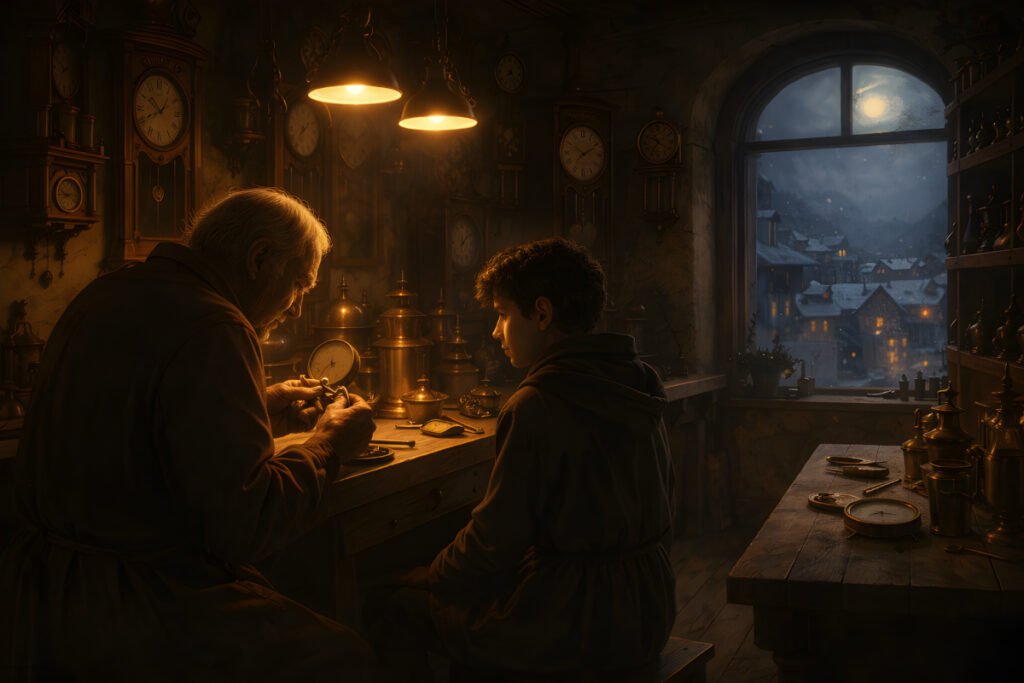
The tower has its own weather. In the early mornings, before the town below has fully woken, the wooden stairs hold the cold of the night in their grain, and the workshop at the top breathes with a stillness that belongs to no particular hour. Dust moves in the shafts of window light. Gears turn. Springs hold their tension. The accumulated voice of a hundred timepieces fills the circular room not as noise but as texture, the way a river fills a valley without ever insisting on itself.
The apprentice arrives each morning before the square comes to life. He has learned, in the months of his training, to walk quietly, to open the small wooden door at the tower’s base without haste, to climb without making the steps announce him. His master is usually already there, standing before one mechanism or another with his head tilted at the particular angle that means he is listening rather than looking.
What they do in the tower is not easily explained to those who have not done it. It involves tools so fine they seem made for other purposes—brushes borrowed from painters, levers that could only be meant for fairy work—and a quality of attention that has more in common with prayer than with repair. A bent gear tooth restored to alignment. A cable seated back into its guide wheel. A grain of dust lifted from between two teeth with a single hair of a brush. Each adjustment is small. The consequences of each small adjustment are not.
Outside the windows, the town keeps its own time. The baker rises before light. The flower seller follows the seasons. Children count the tower’s bronze strikes on their fingers. The fountain murmurs through summer and grows quiet when ice forms at its edges in December. The apprentice watches all of this from above, and gradually begins to understand that the tower does not stand apart from the life below it but is woven into it—that the chimes which mark the hour do not interrupt the daily rhythm of the town so much as give it a place to breathe.
There is a chapter near the end of winter when the bells fall silent. A cable has slipped. The morning passes without its customary announcement, and people in the square look up at the tower without understanding why something feels absent. When the bells return at the half hour—the smallest first, then the middle bells, then the great bronze voice that carries into the valley—the baker looks up from his ovens, the flower seller pauses with her hands full of blooms, and children at the fountain stop to count. For a moment, the entire town moves together in the simple act of listening to time restored.
This is what the tower holds. Not the mechanisms alone, and not simply the hours they measure, but the relationship between the two—the understanding that precision in small things serves something larger than precision, that the careful tending of gears and springs and pendulums is, in the end, a form of care for the people whose days are shaped by what the tower tells them.
- Genre: Poetic architectural sanctuary fiction
- Core Theme: Craft, apprenticeship, the passage of time, continuity
- Main Setting: A clockmaker’s tower workshop in a small Swiss mountain town
- Narrative Focus: A young apprentice learns to tend a collection of timepieces under a master clockmaker’s guidance, discovering that clockmaking is a form of devotion to time itself.
- Emotional Tone: Reflective, contemplative, measured, still
- Ideal Mood — Reading: Best read slowly, in a quiet indoor space, when the mind has settled and the sounds of the day have faded.
- Ideal Mood — Listening: Best listened to in low light or while resting, when the body is still and the rhythm of a quiet voice can take over.
- Length (Kindle): 8,884 words — 40 pages
- Length (Audiobook): Approx. 1 hour 10 minutes
- Narrator: BWC
Collections & Reviews
This story is part of the Embers Before Dreams bundle, a collection of five poetic tales written to quiet the mind.
The audiobook anthology, narrated by BWC, gathers the same stories in one calm listening experience.
Share The Clockmaker’s Apprentice
If this story brought you a moment of calm, you can share it with someone who might need the same.