
The Old Boat in the Orchard
Where Stillness Learns to Breathe
A Peaceful Bedtime Story About Stillness, Memory, and an Old Rowboat Beneath Apple Trees
About This Story
The Old Boat in the Orchard is a short, chapter-structured work of slow fiction set entirely within an apple orchard over the course of a single summer afternoon. A child moves through the trees, discovers an aged wooden boat sheltering among the roots, and spends the hours in quiet observation. The narrative explores found objects, the traces left by earlier lives, and the layered relationship between place and memory. The atmosphere remains still and inward throughout. There is no plot development in the conventional sense; the story moves through mood, sensation, and a gradual deepening of attention paid to a small and overlooked world.
Where the Afternoon Holds Still
There are places that resist the forward movement of time—not by force, but by a kind of patient indifference to urgency. An orchard in full summer is one of them. The trees are thick with the effort of the season, their branches bowed toward the grass, their roots spreading through earth that has absorbed decades of fallen fruit and leaf. Everything here is engaged in work so slow it resembles rest.
A child enters this space without announcement. The grass accepts the footsteps. The bees continue. A blackbird finishes its phrase and begins again. The child moves with the quality of attention particular to those who have not yet learned to be somewhere else while standing in a place, and so the orchard receives this presence fully—as it has received others before, and will again.
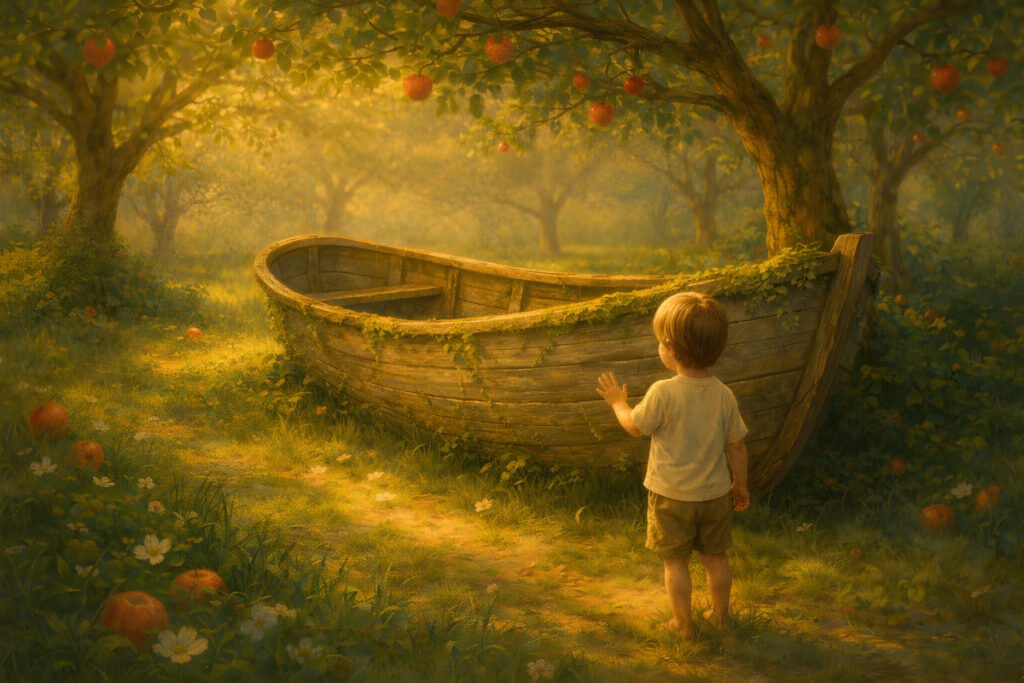
Among the older trees, where three trunks have grown close enough to entangle their lower branches, something else waits. An old wooden rowboat sits grounded on the roots, tilted at the patient angle of a thing that has made its accommodation with the earth and found it sufficient. Moss has taken one side. Ivy has begun a slow inquiry along the bow. The paint is mostly gone, leaving the grain exposed—darkened and honest, marked by weather in the way all things are marked when they are left to the care of seasons rather than hands.
The boat is not remarkable from a distance. It is simply old, and still, and present. But approach changes that. The child moves around it slowly, touching the worn wood at the stern, the brass fitting turned green at the collar, the oar resting against the thwart with the ease of something long undisturbed. Inside, leaves have gathered in the curve of the hull. A few fallen blossoms rest among them. The wooden seats hold the light the way polished surfaces hold light—not reflecting it back exactly, but transforming it into something softer.
To climb in is to enter a different register of time. The boat accepts the child’s weight with a slow creak and settles. The orchard, viewed from within the hull’s low sides, narrows into something more intimate—a ceiling of interlocking branches, light arriving in pieces, the surrounding world present only as sound and scent. It is enough. The child rests against the stern thwart, and the afternoon deepens around this small arrangement of wood and stillness and person.
Later, when the light has shifted toward the amber of mid-afternoon and the shadows of the trees have lengthened across the grass, something is found tucked beneath the forward seat. A ribbon. Blue once, now the uncertain grey-blue of certain winter skies. Silk, or the memory of it, worn to softness by the years it has spent folded in this dry dark place.
The child holds it in both hands, and the orchard continues around them—the bees, the blackbird, the leaves transacting their slow exchange with the light. The ribbon asks nothing and offers nothing that can be named. It is simply evidence: someone was here. Someone placed something small in the keeping of this boat, and the boat held it, through the winters and the springs, through the accumulation of all those quiet afternoons, until this one.
The child does not put it back. Some things are passed forward rather than returned. The boat rocks almost imperceptibly as the child stands to leave, and the orchard receives the departure the same way it received the arrival—without comment, without alteration, already beginning to hold the afternoon among the things it keeps.
- Genre: Poetic countryside reflection fiction.
- Core Theme: Childhood discovery, memory, the passage of time, the presence of the past.
- Main Setting: An old orchard of apple trees in full summer, sheltering a weathered rowboat among the roots.
- Narrative Focus: A child discovers and rests inside an old wooden boat settled amongst apple tree roots, encountering a faded ribbon that connects the present afternoon to unnamed lives before.
- Emotional Tone: Reflective, contemplative, unhurried, nostalgic
- Length (Kindle): 4955 words – 25 pages
- Length (Audiobook): 0 hrs 45 mins 50 sec
- Narrator: Emilynn ler Derna
- Ideal Mood: Evening before sleep
- Available Formats: Kindle & Audible & Apple Books
Collections & Reviews
This story is part of the Whispers Before Dreams bundle, a collection of five poetic tales written to quiet the mind.
The audiobook anthology, narrated by Emilynn ler Derna, gathers the same stories in one calm listening experience.
Share The Old Boat in the Orchard
If this story brought you a moment of calm, you can share it with someone who might need the same.