
The Sand Dunes of Samarkand
Mystical Literary Short Story
A Journey Into the Desert of Wonder
About This Story
The Sand Dunes of Samarkand is a slow, meditative work of desert fiction structured as a single night’s wandering across moonlit dunes. The narrative follows one traveller from a dying campfire through a sequence of dream-like encounters—a phantom camp, hovering lantern flames, a pool that surfaces personal memory, a living tapestry, and a legendary city glimpsed from a high dune. The prose is unhurried and reflective throughout, with no conflict or plot arc. The focus rests on perception, interior stillness, and the quiet dissolution of the boundary between self and landscape as night deepens toward dawn.
Where the Sand Holds Breath
The fire is gone before the walking begins. What remains at the edge of the extinguished camp is not absence but a kind of permission—the quiet understanding that stillness can only be entered when there is nothing left to tend. A brass lantern is lifted, a first step taken on bare feet, and the desert receives both without ceremony.
The sand here does not resist. It yields with each footfall and reforms without urgency, as though accustomed to this rhythm of pressure and release, impression and erasure. The moon above is full, and in its light the dunes take on the quality of water—cresting, curving, folding into valleys where darkness collects like something warm and familiar. There is no path. There has never been a path. And this, it turns out, is the precise condition under which certain things become visible.
The traveller moves through the night without destination, following no map but the quiet pull of attention. A ridge is climbed. A slope descended. A hollow found where the air carries the suggestion of previous occupation—not recent, not quite gone. The sand in such places holds a different texture underfoot, a slight alteration in resistance that speaks less of physical memory and more of something the earth has chosen not to release. A cooking pot’s impression. The faint circular mark where a lantern once stood. No one is here now, and yet the space is not empty.
Further on, small flames hover above mounds of sand—steady, sourceless, each one carrying a particular fragrance into the night. Jasmine. Baking bread. Sandalwood. River grass in early spring. These are not explanations. They are offerings, available to anyone who slows enough to receive them without asking why they are given.
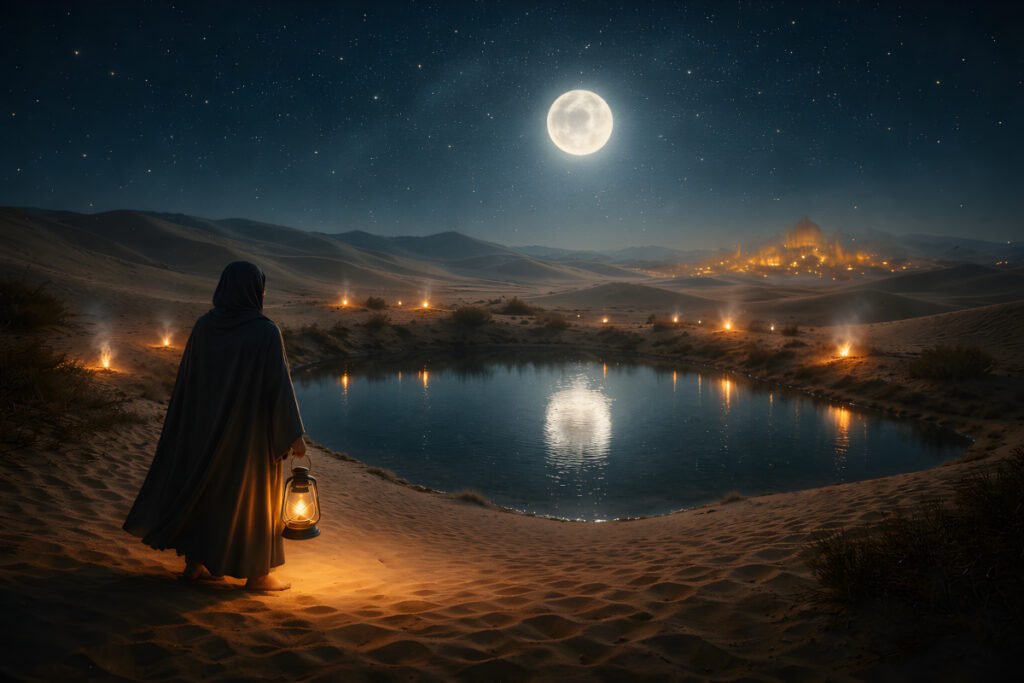
A pool appears where no pool should exist, its surface so still that it holds the full moon without distortion. What is reflected back is not the expected—not sky, not the traveller’s face as it is now—but a succession of moments held in deep storage: a child’s expression of uncomplicated wonder, hands that knew how to make things whole, rooms where light once fell at a particular angle and made the ordinary briefly miraculous. The pool does not demand these memories be interpreted or resolved. It simply presents them, then grows still again.
The night continues its progression through encounters that feel less like events and more like passages between states of awareness. A tapestry suspended in the air. An amphitheatre where stories write themselves into the sand and then continue. A city in a valley below—luminous, unhurried, indifferent to whether it is entered or only witnessed. Each of these encounters asks nothing. Each gives more than can be named.
By the deepest hour before dawn, the distinction between the one who walks and the landscape walked through has softened to the point of irrelevance. The lantern burns on, steady as it was at the start. The sand holds its warmth. The stars maintain their ancient, indifferent brightness. And somewhere in all of this, beneath the accumulated weight of wonder and the accumulated lightness of release, something that might be called rest begins to arrive—not as an ending, but as a recognition that the wandering and the stillness were always, underneath, the same thing.
- Genre: Poetic desert solitude fiction.
- Core Theme: Memory, stillness, wandering, the passage of time.
- Main Setting: A vast desert of shifting sand dunes beneath a full moon on a single night.
- Narrative Focus: A solitary traveller moves through the desert night, encountering phantom camps, floating flames, a reflective pool, and a sleeping city that draw out memories and inner stillness.
- Emotional Tone: Reflective, contemplative, peaceful, absorbed.
- Ideal Mood (Reading): Best read slowly, in a quiet space, when the mind has disengaged from the day and is ready to drift without agenda.
- Ideal Mood (Listening): Best listened to while lying down or resting in low light, when the body is still and the voice can carry the imagery forward.
- Length (Kindle): 7116 words – 32 pages.
- Length (Audiobook): Approx. 1 hour.
- Narrator: BWC
Collections & Reviews
This story is part of the Embers Before Dreams bundle, a collection of five poetic tales written to quiet the mind.
The audiobook anthology, narrated by BWC, gathers the same stories in one calm listening experience.
Share The Sand Dunes of Samarkand
If this story brought you a moment of calm, you can share it with someone who might need the same.