

What People Do When Sleep Does Not Come
About this article
This article explores the behavioural patterns that commonly occur when sleep does not arrive. It describes what people do during wakeful nights — staying in bed, checking the time, adjusting position, getting up briefly, eating without hunger, and reaching for something to occupy attention. These behaviours are presented as natural, instinctive responses rather than deliberate strategies.
The article examines how the mind seeks something to follow when rest does not come, and how silence can increase rather than reduce mental activity. It considers the difference between forms of attention that require effort and those that can be followed passively, and why gentle, continuous input fits more naturally into the wakeful night than active engagement.
Within this context, the article references sleep stories for adults, bedtime stories for adults, and stories to fall asleep to as examples of low-effort, passive accompaniment. These are positioned not as solutions, but as part of the quiet behaviours people naturally move toward during sleepless hours.
On nights when sleep does not come
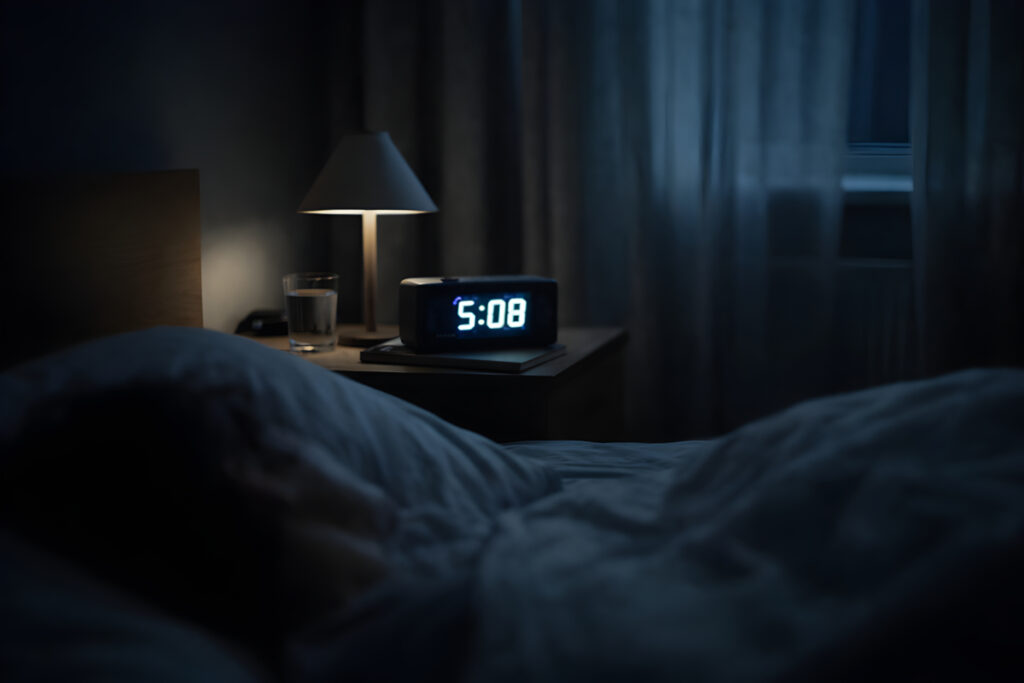
The room is dark and the house has settled into quiet. The body has been still for some time now — long enough that sleep might reasonably have come. But it hasn’t. The night stretches out, unhurried, with no particular regard for tiredness. The mind remains present, not racing, not troubled in any sharp way. Just awake. Awake in a way that feels misaligned with the hour.
This is a familiar kind of night. Not dramatic. Not distressing, exactly. Just the quiet experience of lying there, waiting for something that doesn’t arrive on request.
When the night doesn’t move forward
There is a particular quality to the stillness that settles in when sleep won’t come. The bed is comfortable enough. The room is dark. There is nothing wrong, as such. And yet.
Time behaves differently in these hours. A few minutes can feel extended. The mind registers small things — a sound from outside, the faint shift of light beneath the curtain, the weight of the duvet against the legs.
People check the time. Not because they particularly want to know, but because something in the body reaches for it — a hand moving toward the nightstand, a glance toward the clock, a small automatic gesture made almost without deciding to. A number appears. The night is confirmed to still be moving, even if the person in it isn’t. The hand settles back. The ceiling comes back.
Positions are adjusted. One side, then the other. A pillow moved slightly. These are not acts of restlessness so much as a kind of quiet negotiation — an attempt to find the arrangement that might finally allow things to shift. Sometimes it works. Often it doesn’t. The adjustments continue anyway, softly, for a while.
Small things people begin to do
At some point, staying in bed begins to feel like the harder option. So people get up. Quietly, carefully, as though trying not to disturb anything.
They go to the kitchen. Fill a glass of water. Or put the kettle on — not because tea will resolve anything, but because the small routine of it is something familiar. The sound of the water. The warmth of a mug in both hands. Something to hold while the night continues.
Some people sit somewhere else for a while. A chair in another room. The sofa. The edge of the spare bed. Just a change of place — the same night, experienced from a slightly different angle.
None of this is planned. Nobody is following a method. These are simply the quiet, almost instinctive things the body moves toward when sleep does not come and waiting has run its course.
Eating, even without hunger
Sometimes food becomes part of the night.
Not a meal. Rarely anything deliberate. A piece of bread. Something cold found at the back of the fridge. A few biscuits eaten standing at the counter with the kitchen light left low, or sitting at the table in the dark.
It isn’t hunger, not usually. It’s something else — a rhythm the body recognises from daylight hours, a form of comfort that the hands and mouth already know how to perform. Eating is familiar. It is something to do that requires very little thought and provides a small, steady sensation.
There is no particular meaning in it. It happens, and the night continues.
Reaching for something to follow
Eventually the mind begins to look for something to hold onto.
Often, the phone is what’s closest. Not for any specific reason — a slow movement through things that barely register, a video half-watched, something read and immediately forgotten. The screen offers a faint, continuous signal. Something to follow, even when nothing from it stays.
Others reach for music, or a podcast, or a book — though reading in these hours requires a kind of concentration that isn’t always available. The words can sit on the page without landing anywhere.
What each of these things offers is a thread. Not something to engage with deeply or think carefully about — just something that moves at its own pace, steadily, without requiring a response. A voice. A rhythm. A sequence of sounds or words that the mind can rest against.
This is the quality people are searching for, even if they wouldn’t describe it that way. Not distraction, exactly. Something more like accompaniment. Something to follow while the night passes.
Repeating familiar patterns
Over time, it becomes clear that these nights tend to take the same shape.
The same hour of waking. The same drift toward the kitchen. The same sounds, the same small movements, the same return to bed. Night after night, the same quiet loop repeated with slight variations.
This isn’t failure. It is something closer to the body’s attempt to establish a pattern — a consistent experience that might, through repetition, begin to feel predictable and therefore safe. The mind looks for consistency when rest doesn’t come easily.
There is something almost comforting in the familiarity, even when it isn’t what anyone would choose. At least the night is known. Its shape can be anticipated. The same path through the same darkness, followed again.
When doing nothing becomes harder
Lying in the dark and doing nothing sounds like the simplest thing. In practice, it can be the most demanding.
Silence has a way of filling itself. Not with sound, but with thought. Without anything to follow, the mind turns inward. Small concerns from the day become slightly more present. Unfinished things resurface. The awareness of being awake — in itself — becomes something the mind circles around quietly, repeatedly.
Research highlighted by the British Psychological Society suggests a similar pattern: when external distractions are reduced, the mind tends to become more active rather than less, turning its attention toward internal experience with greater intensity than it might during daylight hours.
This is not anxiety, necessarily. It can be calm and undramatic — just the experience of noticing thought more clearly than usual, without the ordinary buffer of activity around it. For some people, silence is restful. For others, it is precisely what makes the night feel longer.
Why something gentle can feel easier
There is a difference between attention that demands something and attention that can simply be followed.
Reading a complex book asks the reader to hold things in mind, to interpret, to stay engaged. Even light television can pull the eyes and the mind into a kind of active watching. The brain works, even when the content is undemanding. Effort is still involved.
A calm voice moving through a story asks for very little. It continues at its own pace. It doesn’t wait for a response or require anything to be retained. The listener doesn’t have to decide anything or follow anything closely. The voice simply moves forward, and the mind can go with it.
This is why bedtime stories for adults have found a natural place in how some people spend their wakeful hours. Not as a remedy or a technique — just as something gentle enough that the mind can follow without working. Something that provides the thread the night seems to need, without asking for concentration in return.
Sleep stories for adults work in the same way. The pacing is slow. The imagery is quiet. Nothing escalates. And sometimes, without any particular intention, sleep arrives somewhere in the middle of it.
What people are really looking for at night
When sleep doesn’t come, people are not simply waiting for unconsciousness.
They are looking for something that makes the night feel less effortful. Something that allows the mind to release its hold on the hour without forcing it. A way of being awake in the dark that doesn’t require the wakefulness to be resisted or resolved.
The small behaviours — the getting up, the tea, the phone, the sound left playing quietly in one ear — are all expressions of the same search. For something to follow. For something that moves at a steadier pace than thought. For a way through the night that doesn’t depend on the night being fixed.
The mind, at that hour, is not looking for answers. It is looking for something it can move alongside.
The night continues either way. Sleep comes when it comes, with no particular regard for wanting or waiting. And until then, most people find their way through it in small, quiet, unremarkable ways — doing what people do when sleep doesn’t come, one quiet hour at a time.