

The Passport of Forgotten Places
A poetic literary short story of forgotten places
A Room, a Passport, and Lost Places
About This Story
The Passport of Forgotten Places is a poetic bedtime story for adults, structured as a series of journeys within a journey. A traveller sits in a quiet, lamp-lit room with an old leather passport whose stamps open into preserved and abandoned places — a disused railway platform, a submerged village, a floating garden, and a silent festival ground. The story moves through themes of memory, the passage of time, and quiet return. It is written in calm, unhurried prose, intended for evening reading or listening. The tone throughout is restrained and contemplative.
Where the Lamp Still Burns
The room exists at the edge of evening, when the light has turned amber and the day has grown quiet enough to hear itself think. On a small table, beside a candle that has known many such evenings, a passport rests — not the crisp document of modern travel, but something older, softer, its leather the colour of autumn leaves and its pages thick as parchment. Each stamp it bears is not a border crossing but an opening, a threshold into places that no longer exist in the ordinary sense, that live now in the slow, patient geography of memory.
To hold this passport is to understand that distance is not always measured in miles. The traveller who opens it does not pack a bag or check a timetable. She simply turns a page, and the room begins to shift — not disappearing, but remembering, as if the floorboards and the candlelight and the faint scent of cold tea have always known this was possible.
A railway platform wreathed in twilight mist. A market square where a clock stopped at twenty-three minutes past three and decided, reasonably, not to start again. A library beside a river where dust drifts through columns of afternoon light like small worlds in orbit. A village held gently beneath a lake, its streets still intact, its church bells green with age and beautiful with it.
Each place the passport opens is not a ruin but a transformation — somewhere that has continued, quietly, in its own manner, after the people who made it moved on. The empty stalls of the market still hold the shape of what was sold there. The disused railway platform has been colonised by wildflowers, ox-eye daisies and meadowsweet growing through the gaps between sleepers, turning abandonment into a different kind of cultivation. The submerged village is not drowned but preserved, its cobblestones polished by decades of water into something approaching gemstone.
The traveller moves through each of these places without urgency, without agenda. She is not searching for something lost, nor trying to restore what time has altered. She is simply present — the way one is present in a library, or beside a river, or in a room where a candle burns steadily and the evening asks nothing of you. The passport records her passage not with official stamps but with the quiet accumulation of attention, which is the only currency that matters in the territories it opens.
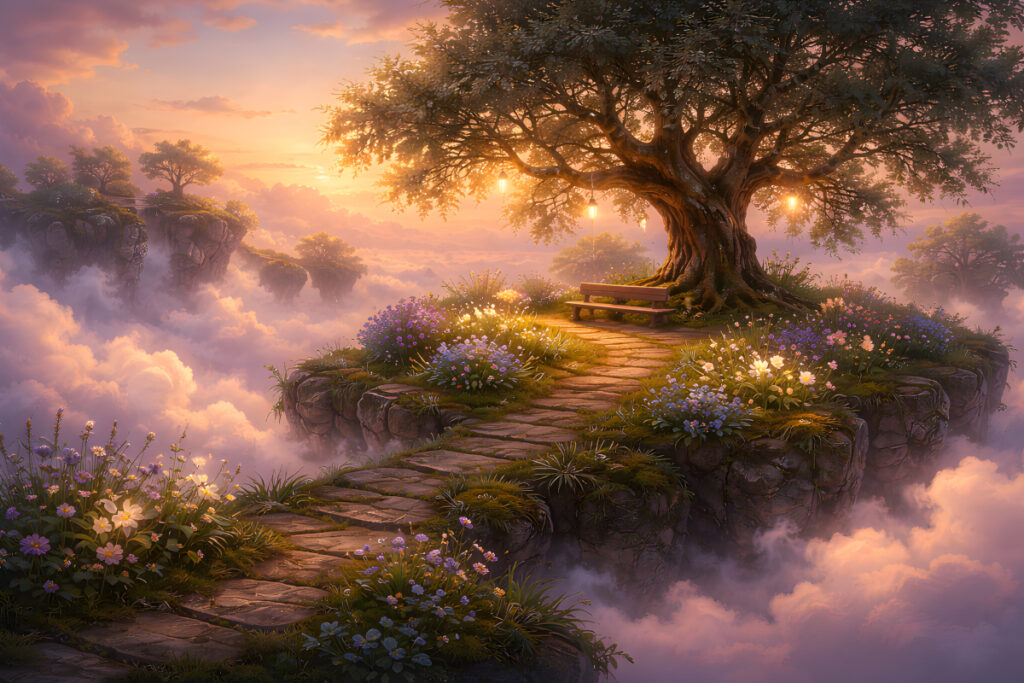
When she returns to the room — as she always does, as the story always does — it is not the same room, or she is not the same traveller, or both things are true simultaneously in the way that only the most honest places allow. The candle has somehow grown taller. The passport glows faintly, warmed from within. Outside the window, the street lamps resemble paper lanterns, and the trees sway as though they carry a memory of growing in gardens above the clouds.
The room settles around her. The tea has brewed itself. New stamps appear in the passport — destinations not yet visited, promises not yet kept. And then, gently, without announcement, the story finds its natural resting place: not an ending, but a pause between one breath and the next, the kind of stillness that comes when a long journey has been completed and the body, the mind, and the imagination have all arrived, together, at last, at home.
Read the Kindle Edition
You can read The Passport of Forgotten Places as a Kindle ebook on Amazon.
The story is available in multiple Amazon stores worldwide.
Choose your Amazon marketplace below:
- Genre: Poetic architectural sanctuary fiction.
- Core Theme: Memory, forgotten places, passage of time, quiet return.
- Main Setting: A lamp-lit room where a worn passport opens into lost and remembered worlds.
- Narrative Focus: A traveller moves through a series of preserved and abandoned places, each unlocked by a stamp in an old passport, before returning to the room where the journey began.
- Emotional Tone: Reflective, contemplative, melancholic, still.
- Reading Mood: Best read slowly, in a quiet room, when the mind is ready to release the day and follow thought at its own pace.
- Listening Mood: Best listened to while resting in low light, when the body is settled and the voice can carry each place into being.
- Length (Kindle): 6078 words — 25 pages
- Length (Audiobook): Aprox. 53 minutes
- Narrator: Peter McGiffen
Retail Audio Invitation
Would you like to hear how Peter McGiffen begins The Passport of Forgotten Places?
Listen to the opening chapter of the audiobook edition below.
Listen to the Audiobook on Audible
Prefer listening before sleep?
The narrated audiobook edition of The Passport of Forgotten Places is available on Audible, performed by Peter McGiffen.
Select your Audible marketplace:
Listen on Apple Books
If you prefer listening through Apple Books, the full audiobook edition of The Passport of Forgotten Places narrated by Peter McGiffen is also available there.
This includes:
- audiobook
- Peter McGiffen
- The Passport of Forgotten Places
Listen to the audiobook on Apple Books
Free Trial
Get the audiobook free with an Audible trial — choose your country:
Collections & Reviews
This story is part of the Mirrors Before Dreams bundle, a collection of five poetic tales written to quiet the mind.
The audiobook anthology, narrated by Peter McGiffen, gathers the same stories in one calm listening experience.
Share The Passport of Forgotten Places
If this story brought you a moment of calm, you can share it with someone who might need the same.