

The Postman Who Wrote Back
Sleep story for adults for quiet reflection and gentle emotional rest
Letters from a Village Post Office
About This Story
The Postman Who Wrote Back is a short work of contemplative fiction set in the English village of Millbrook. It follows a recently retired postman who returns each evening to the old post office, where a wooden box of letters that could never be delivered has accumulated over forty-seven years of service. Moving through the quiet rituals of lamplight and tea, he reads these interrupted correspondences and finds ways to honour the words they contain. The story is written in British English and has a calm, unhurried prose rhythm suited to evening reading.
Lamplight and Undelivered Words
The light at half past five arrives in the post office the way it always has — slowly, through old glass, pooling across the worn wooden floor as though reluctant to disturb the quiet. Thomas Hartwell moves through it with the unhurried ease of a man who has long since made peace with the pace of things. At sixty-three, he knows the weight of ten thousand letters. He knows the particular silence of a room that has held other people’s words for decades without ever opening them.
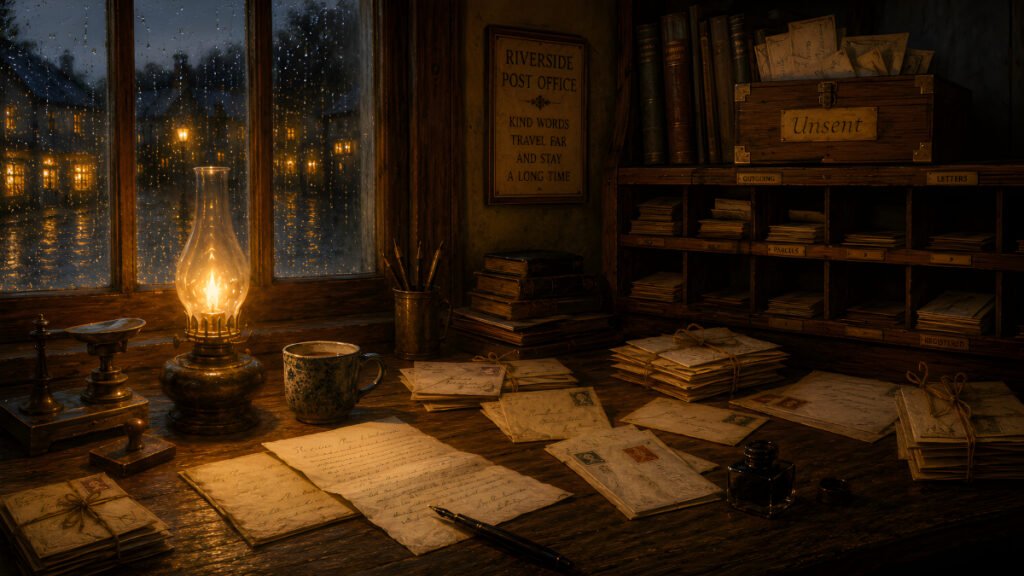
He is no longer the postman. He retired six months ago, and the brass key turns in the lock out of habit now, out of something older than duty. Inside, nothing has changed: the sorting desk, the wooden pigeonholes, the ancient scales that weighed parcels of birthday wishes and final farewells with the same indifferent precision. He makes his tea — Earl Grey, two sugars, the chipped blue mug — and stands at the window while the kettle finds its slow voice. Outside, the village is settling into its evening rhythm. Cobblestones darken with the first touch of rain. The bakery windows cast amber rectangles onto the wet street.
On the high shelf behind the desk sits a plain pine box with brass corners dulled to the colour of old pennies. It is labelled in Thomas’s own handwriting: Unsent. Over forty-seven years, he had gathered them — letters with addresses too incomplete to act on, envelopes damaged beyond legibility, words that had entered the postal system and found nowhere to go. Standard procedure had always been clear. He had never quite followed it. Something about the weight of undelivered words, the sense of a sentence interrupted mid-thought, had made disposal feel like a particular kind of loss.
So the box had grown. Love letters to sweethearts who had moved without leaving a forwarding address. Condolence cards for the recently bereaved. A child’s careful envelope addressed to the Tooth Fairy, care of under her pillow. Apologies that had taken too long to be written and longer still to post. Each one a bridge begun but never completed, each one evidence of the human insistence on reaching across whatever distances separate one heart from another.
Thomas lifts the box down from the shelf and sets it on the sorting desk. He does not open it immediately. He sits with it in the lamplight, his hands resting on the familiar wood, listening to the rain begin in earnest against the windows. The village sounds recede. The church bell marks six o’clock.
What follows over the coming weeks is neither rescue nor restoration. He does not know where Robert Thornbury is now, or whether Mrs Thornbury found the peace she wrote toward. He does not know if Lucy’s mother ever found happiness again, or whether David ever found the girl from the train. He reads, and where the words seem to call for it, he writes back — not as the intended recipient, but as someone who has borne witness. A fellow traveller. Someone who understands that words committed to paper with care are not diminished by failing to arrive.
The letters that ask nothing are left as they are. A single sheet bearing the word FORGIVENESS in bold letters. A child’s drawing of a woman surrounded by cats. A piece of handwritten music titled For Eleanor. These are not failures of communication. They are offerings, complete in themselves, sent into the world without expectation of return.
And through the long evenings of that winter — the lamplight holding its quiet circle, the wooden box growing slowly lighter — Thomas comes to understand something that his years of postal service had not quite taught him: that delivery is not always the point. That the attempt itself has weight. That every word sent with sufficient care finds its way, eventually, to wherever it needs to go.
Read the Kindle Edition
You can read The Postman Who Wrote Back as a Kindle ebook on Amazon.
The story is available in multiple Amazon stores worldwide.
Choose your Amazon marketplace below:
- Genre: Poetic countryside reflection fiction
- Core Theme: Undelivered words, human connection, the persistence of love, the passage of time
- Main Setting: A quiet village post office in late afternoon, holding decades of undelivered letters
- Narrative Focus: The story centres on a retired postman who reads and responds to undelivered letters in the evening stillness of a village post office.
- Emotional Tone: Reflective, contemplative, quiet, gentle
- Reading Mood: Best read slowly, in a quiet room, when the day has softened and the mind is ready to rest with unhurried thought.
- Listening Mood: Best listened to in low light or while resting, when stillness has settled and the voice can carry the words without effort.
- Length (Kindle): 12,590 words — 50 pages
- Length (Audiobook): Aprox. 1 hour 28 minutes
- Narrator: Peter McGiffen
Retail Audio Invitation
Would you like to hear how Peter McGiffen begins The Postman Who Wrote Back?
Listen to the opening chapter of the audiobook edition below.
Listen to the Audiobook on Audible
Prefer listening before sleep?
The narrated audiobook edition of The Postman Who Wrote Back is available on Audible, performed by Peter McGiffen.
Select your Audible marketplace:
Listen on Apple Books
If you prefer listening through Apple Books, the full audiobook edition of The Postman Who Wrote Back, narrated by Peter McGiffen, is also available there.
This includes:
- audiobook
- Peter McGiffen
- The Postman Who Wrote Back
Free Trial
Get the audiobook free with an Audible trial — choose your country:
Collections & Reviews
This story is part of the Voices Before Dreams bundle, a collection of five poetic tales written to quiet the mind.
The audiobook anthology, narrated by Peter McGiffen, gathers the same stories in one calm listening experience.
You can choose your Amazon or Audible marketplace in the sections above if you’d like to leave a quiet review.
Share The Postman Who Wrote Back
If this story brought you a moment of calm, you can share it with someone who might need the same.
Audiobooks narrated by Peter McGiffen
The Pillowmakers Garden
The Last Bus to Stillwater

Echoes Before Dreams – 5 Adult Bedtime Stories

The Beacon Tower

The Passport of Forgotten Places

The Inn at the Edge of the Dunes

Lanterns Over the Lavender Hills
The Mirror in the Antique Shop
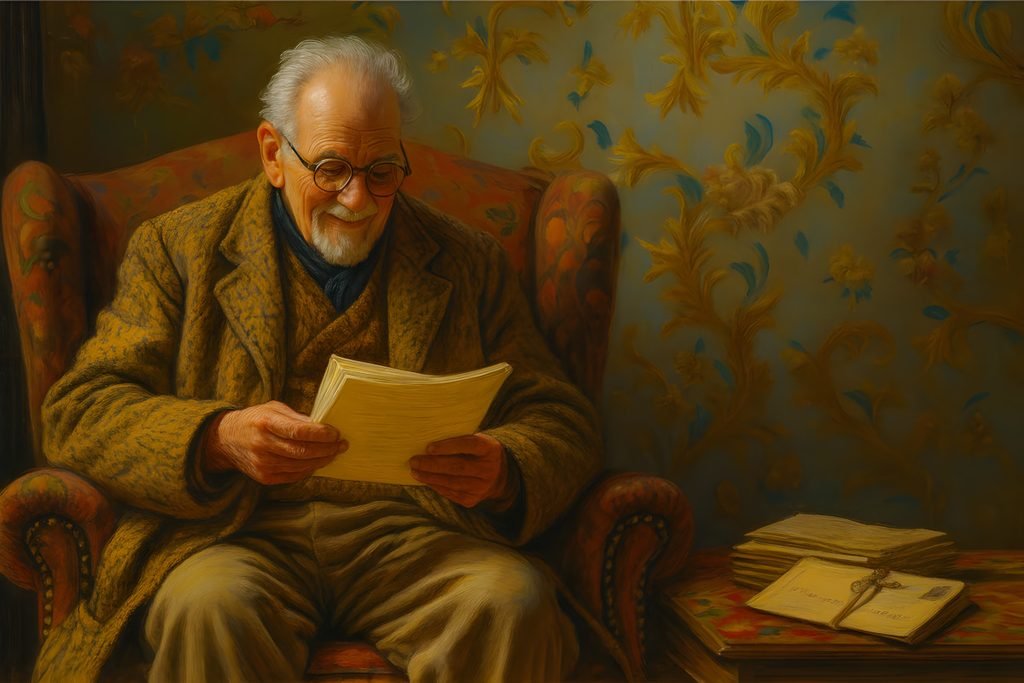
Letters From the Old Postmaster
The Monastery by the Sea

Voices Before Dreams

The Bookshop with No Clock

The Room Without Corners
The Window Above the Bakery

The Observatory That Watched Back

Ink in the Shape of Silence
The Train to Lavender Station

The Train That Never Hurries

Paper Boats on the River of Time

The Garden of Starlight